
Key takeaways
- Start with the gas and release consequence, not a cabinet feature list.
- Compressed-gas storage rules extend beyond the cabinet itself.
- Exhaust, detection and shutdown functions require coordinated engineering.
The short answer
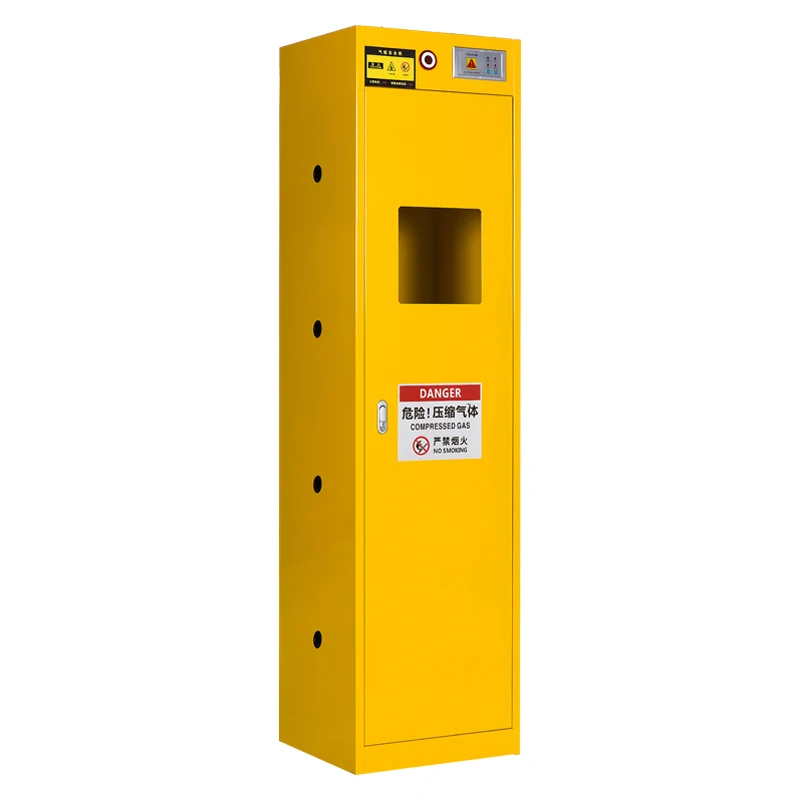
Some gas-cylinder cabinet installations require ventilation; others follow a different approved storage arrangement. The answer depends on the gas hazards, cylinder inventory, indoor or outdoor location, applicable code, room ventilation and the facility’s release-control strategy.
Choose among gas cylinder cabinet models only after those inputs are recorded. A vent collar in a product image is not an engineered system.
What the federal baseline establishes
OSHA 29 CFR 1910.101 requires in-plant handling, storage and use of compressed gases to follow the incorporated Compressed Gas Association provisions and requires employers to determine that cylinders are in safe condition through applicable inspections. Gas-specific OSHA standards may also apply.
The federal baseline does not replace state and local fire codes, building requirements, adopted code editions or AHJ decisions. The project team must identify the jurisdiction and gas-specific rules rather than treating one national citation as the complete design basis.
- 01Start with the gas and release consequence, not a cabinet feature list.
- 02Compressed-gas storage rules extend beyond the cabinet itself.
- 03Exhaust, detection and shutdown functions require coordinated engineering.
Define the release problem
| Input | Why it changes the design |
|---|---|
| Gas identity | Flammability, toxicity, oxidizing or asphyxiation hazard |
| Cylinder size/count | Potential release inventory |
| Indoor/outdoor location | Dispersion and exposure conditions |
| Gas density | Detection and exhaust capture strategy |
| Operating state | Storage only, connected supply or changeover |
| Emergency response | Alarm, shutdown, evacuation and responder access |
Treat the cabinet as one part of a system
Where ventilation is required, the cabinet, duct, fan, discharge, make-up air, monitoring and emergency controls must work as a system. Materials and electrical equipment must suit the identified hazards. Airflow must be commissioned and maintained rather than assumed from fan nameplate data.
The gas cylinder storage planning page should carry the site inputs, while a model-specific drawing request captures cabinet dimensions and connection points.
Ventilation and detection answer different questions
Ventilation aims to control or remove a release; detection identifies a condition and may initiate an alarm or other response. One does not automatically replace the other. Sensor technology, set points, placement, calibration and response actions are gas- and project-specific.
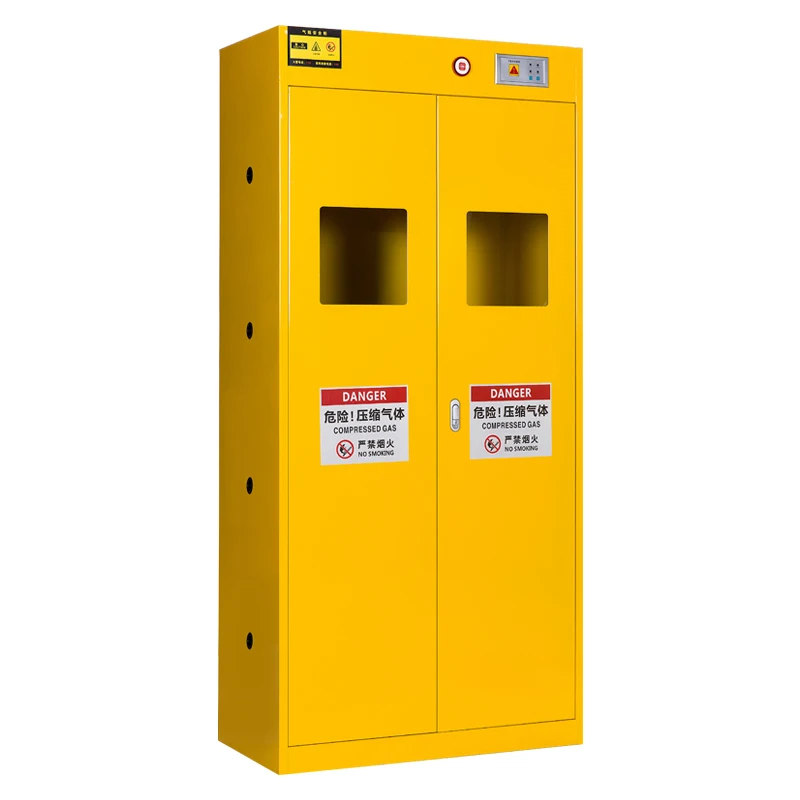
Do not advertise a generic alarm opening or detector bracket as proof of a complete gas safety system. Request the exact supplied components, interfaces and exclusions.
Cabinet selection still requires physical fit
Follow the gas cylinder cabinet selection guide to record cylinder diameter, height, valve/regulator clearance, restraints and door opening.
A technically suitable exhaust concept can still fail if the cylinder cannot be loaded safely, restraints do not align with the cylinder body, or service connections interfere with door operation.
Gas cabinet project brief
- Gas name, SDS and hazard classification
- Cylinder specification, count and connected/reserve status
- Room and destination jurisdiction
- Required exhaust flow or design basis, if established
- Detection, alarm and shutdown interfaces
- Duct connection and discharge information
- Required drawings, specifications and approval documents
- Commissioning and maintenance responsibility
Design from a credible release scenario
The design team should identify whether the concern is a leaking valve, failed regulator, open connection during cylinder change, tubing failure or another credible event. Gas identity and release rate affect dispersion, detection and exhaust needs. A toxic gas, flammable gas, oxidizer and inert asphyxiant cannot be given one generic cabinet-ventilation answer merely because each arrives in a cylinder.
Document how an alarm is detected, who receives it, which automatic actions occur and how responders verify conditions. If shutdown valves, gas detectors or building controls are included, define ownership of wiring, programming, calibration and periodic testing. The cabinet supplier’s scope may end at physical mounting points; the complete safety function belongs to the coordinated project design.
- Confirm exhaust and detector assumptions with the gas SDS.
- Show duct, sensor and service penetrations on coordinated drawings.
- Commission alarms and interlocks under the facility procedure.
- Retain test and maintenance records with the system asset.
Assign ownership across the complete gas system
Create an interface matrix covering the cabinet, cylinders, regulators, manifold, valves, tubing, exhaust, detector, alarm, building controls, power and emergency response. Name the designer, supplier, installer, commissioner and maintainer for each item. This prevents gaps where every party assumes another party supplied or tested a safety function.
Coordinate set points and actions before installation. Document what a detector alarm means, whether it closes a valve, starts or confirms exhaust, signals the building system, or only warns occupants. The appropriate sequence is gas- and project-specific and must be tested as an integrated function.
At handover, collect cabinet drawings, component manuals, commissioning records, calibration requirements and emergency procedures. Train the people who change cylinders and those who respond to alarms. Reassess the system when gas service, cylinder size, room use, exhaust or controls change; the original approval does not automatically cover a new release scenario.
References
- 29 CFR 1910.101 — Compressed GasesU.S. Occupational Safety and Health Administration
- 29 CFR 1910.1200 — Hazard CommunicationU.S. Occupational Safety and Health Administration
Sources support the cited regulatory and safety context. They do not certify a Safatrix product or replace model documentation and project review.