Identify the liquids
Send the chemical names, SDS and container types.
 Request a Quote
Flammable liquid storage
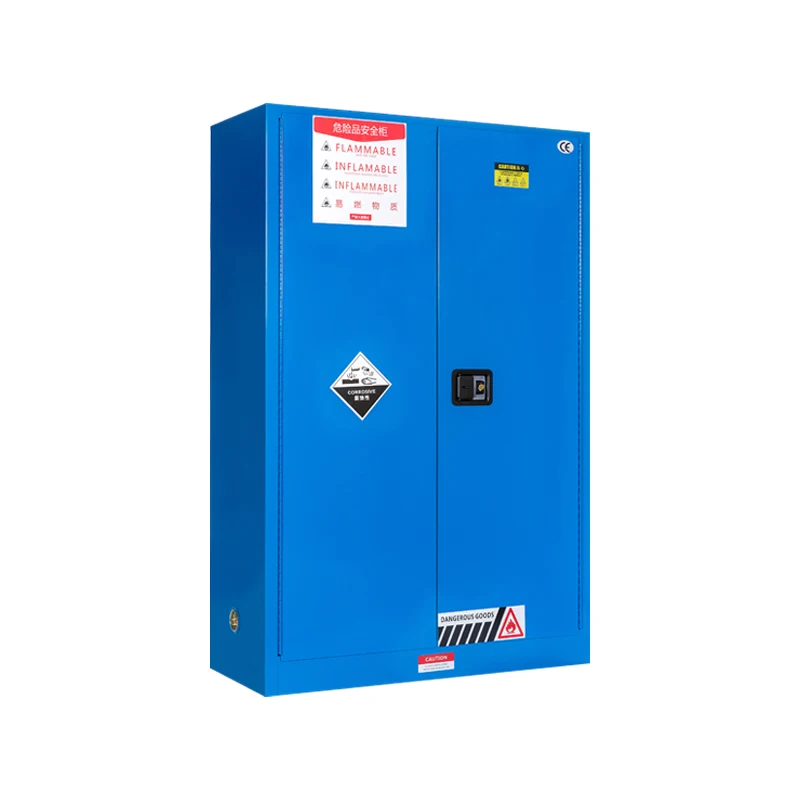
Select a flammable liquid storage cabinet around the liquid classification, container inventory, usable internal layout, door operation and installation area.
This guide covers packaged liquids used in laboratories, workshops and industrial facilities. Bulk tanks, storage rooms and dispensing systems require a separate engineering route.
Decision path
The selected cabinet still depends on the stored material, dimensions, quantity and project documents.
Send the chemical names, SDS and container types.
List container sizes, quantities and expected maximum volume.
Review material, capacity, dimensions, doors and shelves.
Ask for the specifications and documents required by your project.
Application fit
Daily-use solvents and flammable reagents stored in bottles or safety cans near laboratory work areas.
Packaged solvents, cleaners, coatings or process samples kept at a defined point of use.
Small containers of fuels, thinners, aerosols or cleaning liquids that require organized indoor storage.
Limited working stock held outside a central store, subject to the facility inventory and fire-safety plan.
Configuration guide
These routes narrow the search. Confirm dimensions, construction and available features on the selected model.
Check the tallest container, shelf spacing, door clearance and the number of containers used each day.
Confirm internal dimensions and shelf loading; a gallon label alone does not prove the containers will fit.
Define drum size, quantity, handling method and whether pumps or dispensing equipment are involved.
Check available height, bench overhang, door swing, ventilation decisions and nearby ignition or heat sources.
State the project requirement and daily workflow; verify the exact closing mechanism on the selected model.
Selection conditions
Use the table to compare cabinet routes before choosing a model. Final chemical compatibility and site approval remain part of the facility review.
Scope
Use another route when
Common mistakes
Nominal cabinet capacity does not replace container count, shelf layout and usable interior dimensions.
The SDS identifies storage conditions and incompatibilities that a short product name may miss.
Ventilation decisions belong to the site review; do not infer them from a product photograph.
Verify the exact model, label and supporting files requested by the project.
Product route
Review available models, then send the stored liquid, quantity and destination with your quotation request.
Buyer questions
Answers define the next check; they do not replace the SDS, facility review or selected-model documents.
Start with the chemical names and current SDS, then list every container size, quantity and expected maximum stock. Add the installation space, delivery country and any document or approval requirement stated by the project.
No. The gallon rating does not describe a universal bottle count. Internal width, depth and height, shelf positions, sump area, doors and container shape determine the usable arrangement. Confirm the selected model drawing against the largest container.
Do not decide from the cabinet title alone. A chemical can have more than one hazard, and incompatible materials may require separation even when both are flammable. Review each SDS and the facility compatibility plan.
OSHA 29 CFR 1910.106 includes quantity limits and construction provisions for covered flammable liquids. Those rules provide project context; they do not prove that a Safatrix model complies. Verify applicability and the exact model documents.
There is no universal answer for every chemical and room. Vent openings on a cabinet do not by themselves determine whether they should be connected. The facility team should review the SDS, room design, local requirements and any exhaust connection details for the selected model.
Request the selected model's available external and internal dimensions, shelf arrangement, door configuration, material information, drawings, labels and supporting records named in the project specification.
Safety references
These external sources support storage questions. They do not certify a Safatrix model or replace local code and facility approval.
Product files
Send the model, quantity, destination country and required drawings or documents.
RFQ intake
Email the cabinet family, stored item, quantity, destination country and required documents, or contact Safatrix on WhatsApp for a quick product discussion.
Direct contact
Use email for product lists, drawings and document requests. Use WhatsApp for a quick discussion about models, quantities or customization.